Standards-enforced intelligence reports
Assessments that show their evidence.
Give Corelata your source material and a statement of its intelligence value. A team of agents checks the statement against the sources, drafts an ICD 203-shaped assessment, edits it for the reader and audits it rule by rule against a standards pack you can replace. You get the finished report with every claim linked to the passages that support it, and a trace of how it was made.
What it does
From sources to a finished, checked report
Corelata produces one report product: an analytic assessment shaped by ICD 203, with key judgments in its likelihood and confidence language, sourcing, analysis, alternatives considered, and gaps and indicators. It runs unattended from the moment an analyst starts it to the delivered report, then the analyst reviews the report and its trace and accepts it or returns it with a note.
Reports export as Word (DOCX), HTML, Markdown and a JSON trace of the run: every stage, every model call, every rule verdict and every revision. Any export can be reproduced from the stored trace alone.
Who it is for
Analytic teams that write to ICD 203 and ICD 206
Corelata is built for analysts and the teams that review their work, including teams on networks with no internet access that run their own language models. Teams with their own reporting conventions each get a profile: tone, headings, template limits, handling markings, and the rules they disable or re-grade.
It is not a collection tool, a search engine over your holdings or a chat assistant. It takes material the analyst already has and produces a report.
How it works
Four agents, each with one job and a bounded role
-
Value gate
Checks the value statement against the sources before anything is written. If the sources do not support it, the run stops with the reasons instead of writing a report the sources cannot carry. It can also suggest statements from the sources.
-
Writer
Drafts the assessment in the pack's template. Every claim cites the source passages it rests on; a citation of a passage the run does not have is refused and sent back for repair.
-
Conveyance reviewer
Edits the draft for the reader, in the team's tone and format. It may reword; it cannot change the set of claims.
-
Compliance auditor
Gives a verdict on every rule of the pack, citing the passages and claims it relied on. It never edits the report: its output has no field for report text.
One bounded revision loop
Blocking and major findings go back to the writer or the conveyance reviewer, whichever the rule names, for up to two revision rounds by default. The engine, not a model, decides from the rules' severities whether another round runs. The auditor's reasoning stays in the trace; only its structured findings are passed on.
The report is delivered
Once there is a draft, there is a report. Findings still open after the last round are listed in the report under "Audit findings open at delivery", and if the reviewer or the auditor cannot finish, the report goes out with a note naming the incomplete stage. Only a value check the sources do not support, or a writer that cannot produce a draft, ends a run without one.
Every claim linked to its evidence
Sources are split into units (paragraphs, table rows, records) with a locator each, and every claim in the report cites the units that support it. The review screen highlights a claim where it is cited and shows the passages beside it; the HTML export carries the claim ids on every paragraph.
A standards pack you can replace
The rules live in a structured, versioned pack directory. Corelata ships
ICD 203 and ICD 206 as the base pack, with the ICD 203 likelihood
and confidence lexicon. You tune it, extend it, or replace it on your own
deployment; corelata pack diff compares packs and profiles, and
corelata profile extract drafts a team profile from that team's
finished reports.
- 17
- rules in the ICD 203 and ICD 206 base pack
- 12
- verifiable from the text: pass, fail or not applicable
- 5
- advisory, such as "Timely": attested with a note, never blocking
- 2
- revision rounds by default, set per deployment or per report
Demo
A report, start to finish, in the review UI
Recorded on 6 November 2026 with Corelata 0.1.8 running locally against its synthetic test model: a deterministic stand-in that ships with Corelata for tests and demonstrations. No language model is involved, so the prose is placeholder text ("Synthetic assessment…") and writing takes under a second. With a real model the steps and screens are the same and writing takes minutes.
27 seconds, no sound, with captions. The captioned screenshots below show every step of the same journey.
-
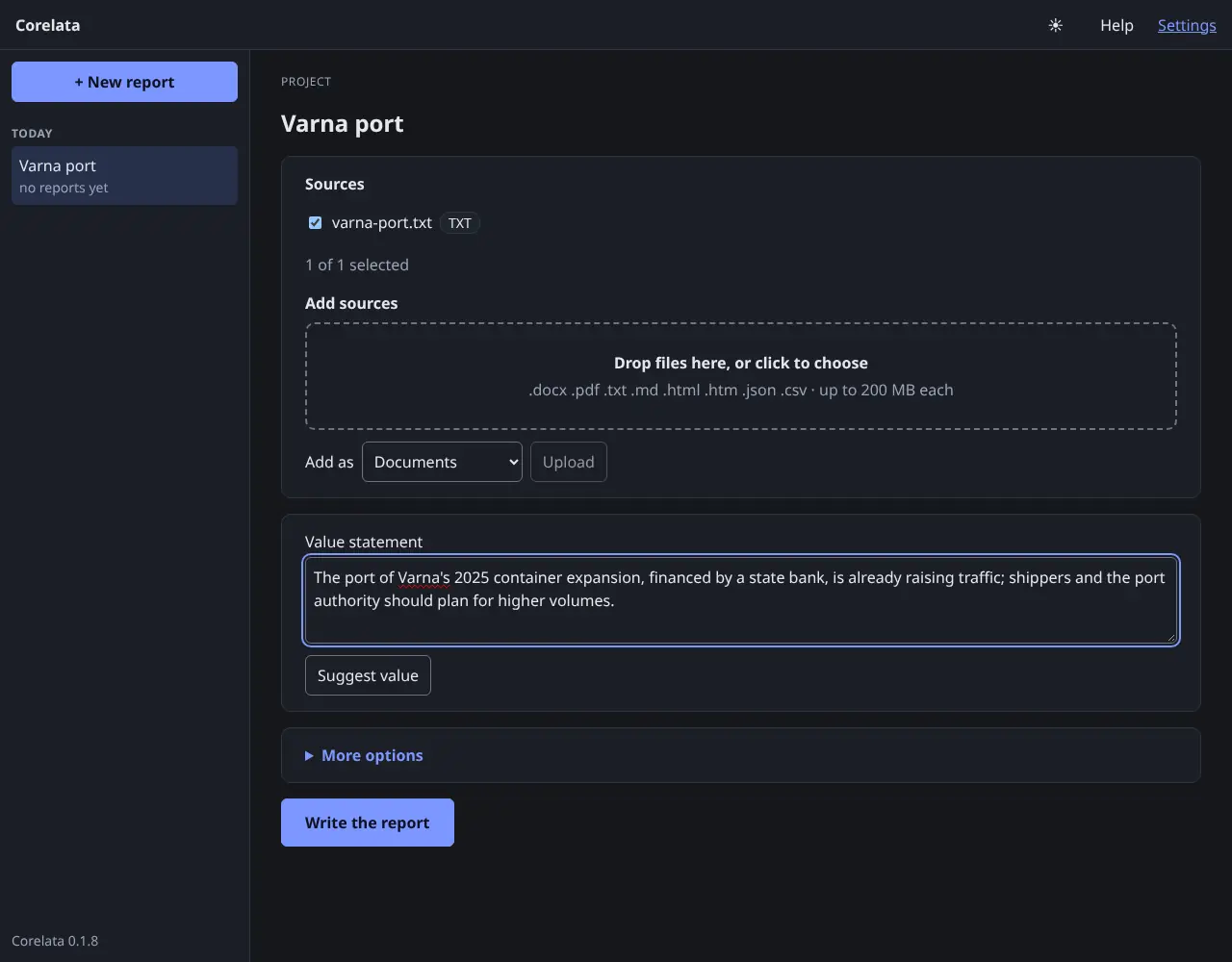
A new report A project, its source (the sample varna-port.txtthat ships with Corelata) and the value statement: what the report is for and why it matters. Sources can be documents (DOCX, PDF, TXT, Markdown, HTML, JSON, CSV) or Coglossa exports; Suggest value proposes statements from the sources instead. -
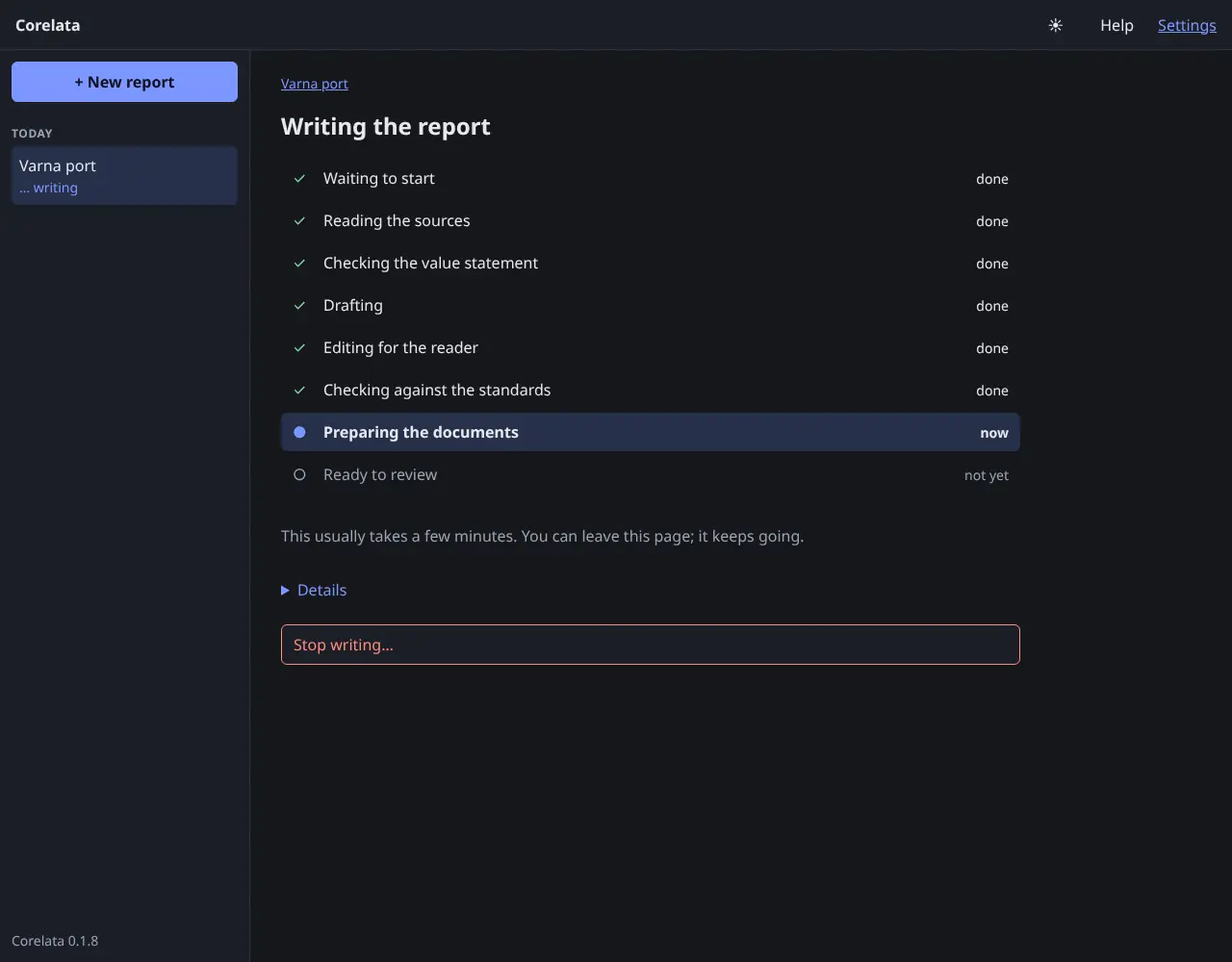
Writing, unattended The run works through its steps: reading the sources, checking the value statement, drafting, editing for the reader, checking against the standards and preparing the documents. The analyst can leave the page; the run keeps going. -
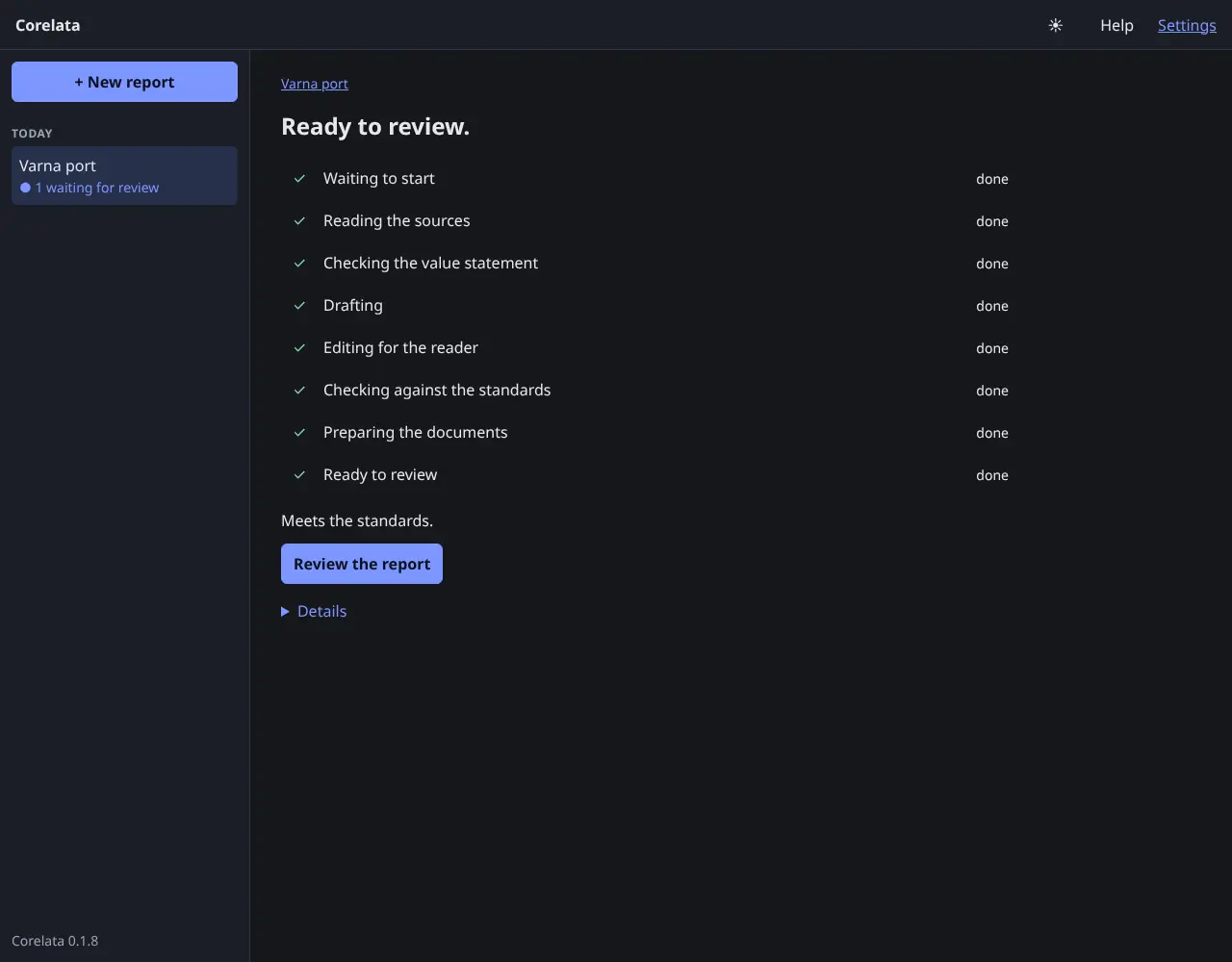
Ready to review Every step is done and the report meets the standards. A report with findings still open is delivered the same way and says so. -
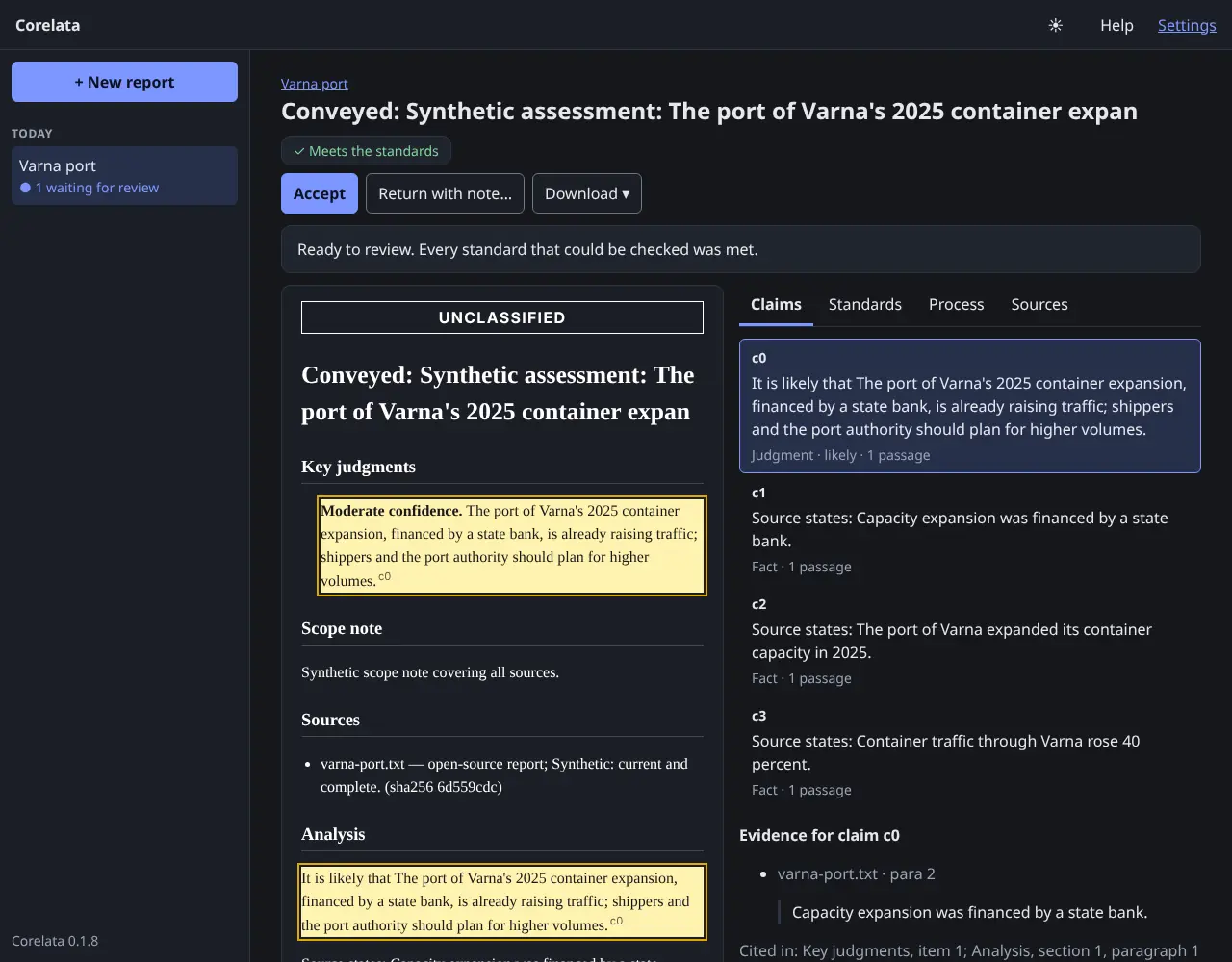
Claims, linked to evidence The report beside its claims, each a judgment (with its likelihood term) or a fact. Choosing a claim highlights everywhere it is cited and lists its evidence: the source, the passage, and where in the report it is cited. -
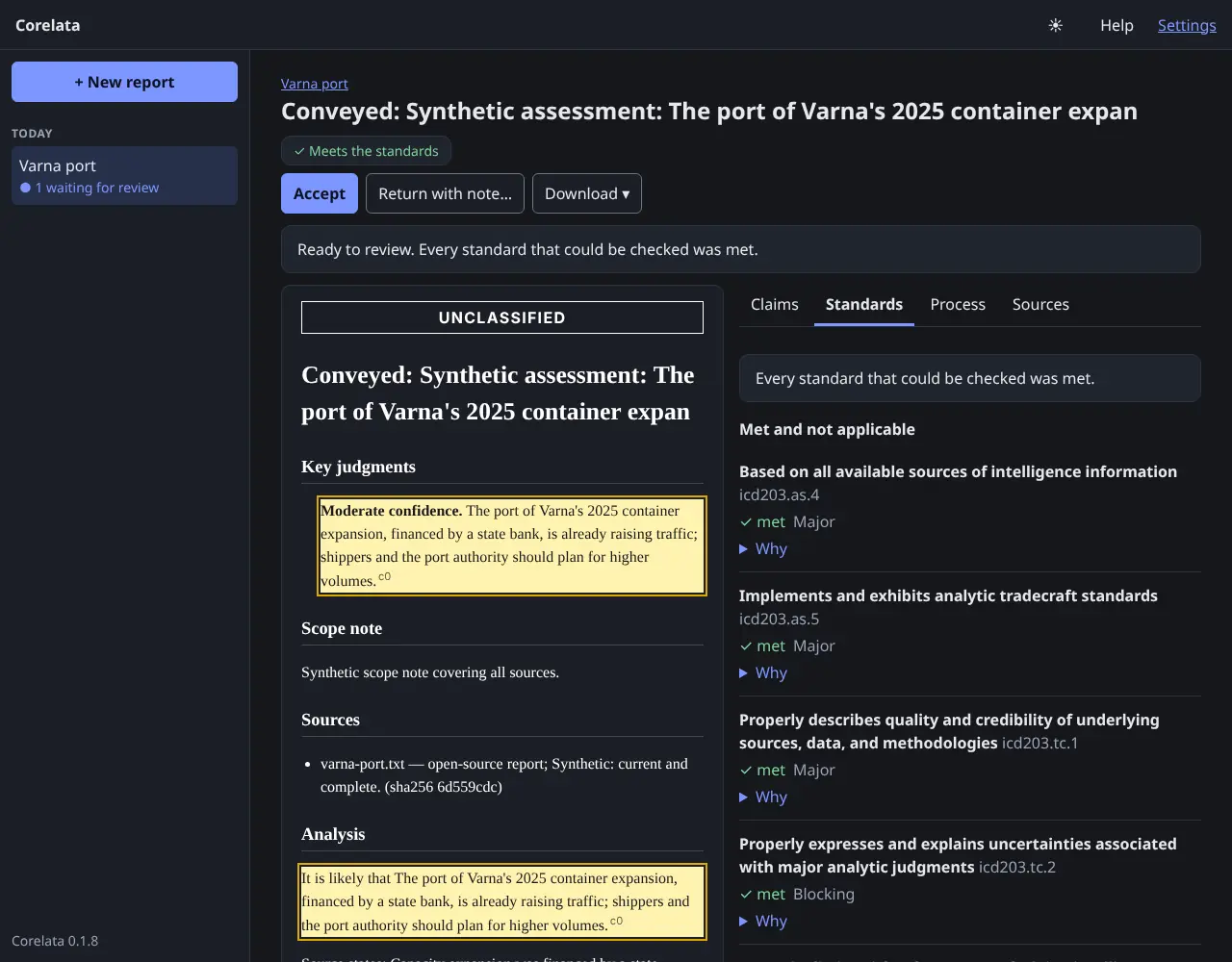
The standards audit The auditor's verdict on every rule of the pack, grouped as not met, minor issues, met and not applicable, and advisory, each with its rule id, its severity and the auditor's reasoning under Why. -
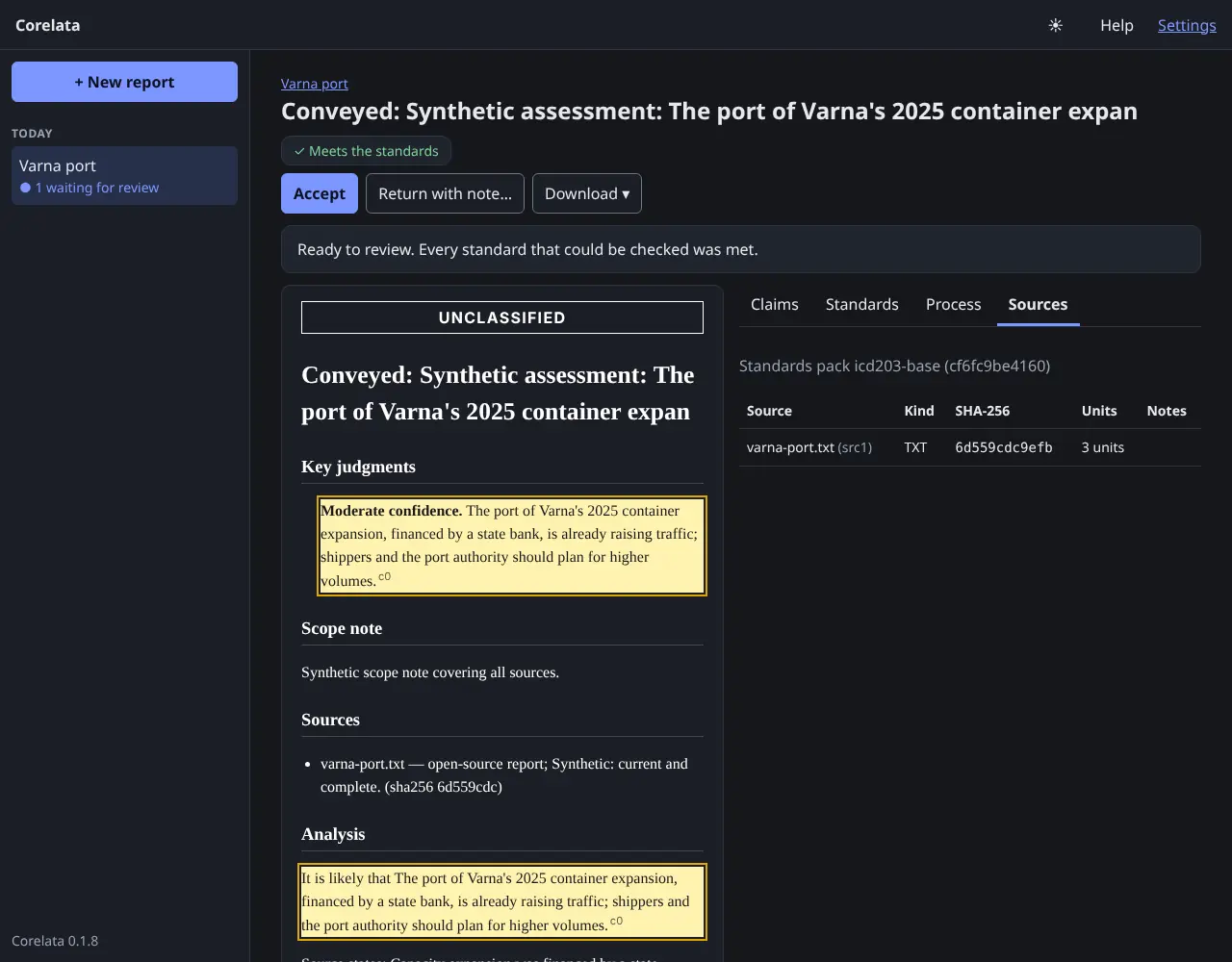
The source trail Each source with its kind, SHA-256 and the units it was split into, and the standards pack, with its hash, that the report was checked against. The Process tab lists every stage, every draft and the model usage.
Sample output
A real run's report, trace and audit findings
The sample page shows what one run produced, exactly as Corelata exported and printed it: the report in all four formats, one claim's source trail, the auditor's findings on the first draft, and the revision that fixed them.
Run it
On your hardware, with your models
Corelata runs on one Linux host under Docker Compose and never needs the internet, at install or at run time. It ships as an offline bundle: the images, a configuration template, the base standards pack, install, backup and restore scripts, the operator guide, software bills of materials and a checksum for every file.
The only servers it talks to are
your own OpenAI-compatible model servers: vLLM, Ollama, TGI, a
llama.cpp server, LM Studio, or anything with an OpenAI-compatible
/v1 API. Each agent role can use a different model.
corelata doctor checks the configuration, prompts, pack, models, database
and storage, sending the same requests a run sends.
What comes with it
- A web review UI, an HTTP API and a command line, over one engine
- Postgres for runs, sources and reviews; a worker queue that runs reports unattended
- Sign-in through your reverse proxy (a trusted header); reviews record who decided
- A bench that measures your models against scenario sets before you trust them
There is also a password-protected hosted demo for demonstrations, which runs the same engine against hosted models. Ask matt@bonham.tech for access or for the bundle.
Licence
Apache-2.0
Corelata is licensed under the Apache License, Version 2.0. It is made by Bonham Technologies, LLC.